Most marketing teams measure campaign success using metrics such as conversion rate, revenue generated, or bonus redemption rate.
The problem is that these metrics often fail to answer the most important business question:
Did the campaign actually change customer behavior?
This is where uplift analytics becomes essential.
Understanding Uplift Analytics
Uplift analytics is a methodology used to measure the true incremental impact of a marketing action, promotion, or bonus offer.
Instead of asking:
"How many customers converted?"
Uplift analytics asks:
"How many customers converted because of the campaign?"
The distinction may seem subtle, but it can dramatically affect marketing decisions and profitability.
For example, imagine a player deposits after receiving a bonus offer. Traditional reporting would attribute that deposit to the campaign.
However, what if the player would have deposited anyway?
In that case, the bonus generated no additional value and simply reduced profit margins.
Uplift analytics helps identify the difference.
The Problem with Traditional Performance Metrics
Many organizations rely on metrics such as:
- Open rate
- Click-through rate
- Conversion rate
- Bonus redemption rate
- Total revenue
While useful, these metrics cannot distinguish between:
- Customers who were influenced by the campaign
- Customers who would have converted regardless
As a result, marketing teams often overestimate campaign effectiveness and overspend on incentives.
This issue becomes particularly expensive in industries where bonuses, discounts, or promotional credits represent a significant cost.
How Uplift Analytics Works
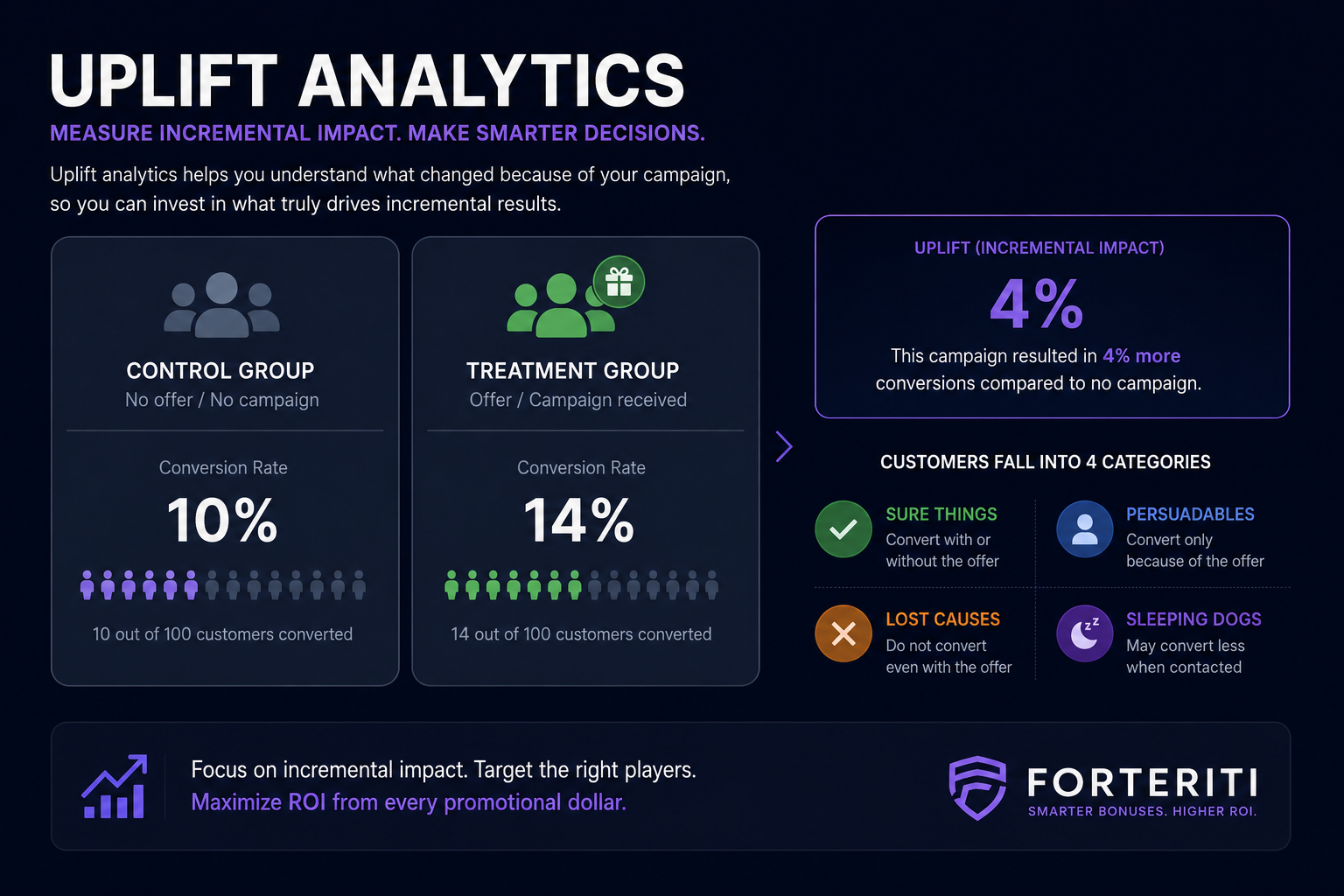
The foundation of uplift analysis is the comparison between two groups:
Control Group
Customers who do not receive the campaign.
Treatment Group
Customers who receive the campaign.
By comparing outcomes between these groups, organizations can estimate the campaign's incremental impact.
The basic uplift formula is:
Uplift = (Conversion Rate of Treatment Group) − (Conversion Rate of Control Group)
If:
- Treatment conversion = 14%
- Control conversion = 10%
Then the campaign uplift equals 4 percentage points.
This means that 4% of customers converted specifically because of the campaign.
Why Uplift Matters More Than Conversion Rate
Consider two promotional campaigns.
Campaign A
- Conversion Rate: 25%
- Uplift: 2%
Campaign B
- Conversion Rate: 15%
- Uplift: 7%
Traditional reporting would likely declare Campaign A the winner.
However, Campaign B generated significantly more incremental conversions and therefore created more real business value.
Without uplift analytics, companies often optimize for the wrong outcomes.
Uplift Analytics in Bonus Optimization
The concept becomes especially valuable when managing promotional budgets.
Many operators distribute bonuses to broad customer segments under the assumption that more bonuses generate more activity.
In reality, customers typically fall into four categories:
Sure Things
Customers who will convert regardless of receiving a bonus.
Persuadables
Customers who convert only because they received an offer.
Lost Causes
Customers who are unlikely to convert even with an incentive.
Sleeping Dogs
Customers who may react negatively when contacted.
The most profitable campaigns focus on Persuadables.
Uplift analytics helps identify these customers and allocate bonuses more efficiently.
Measuring Incremental Revenue
One of the biggest advantages of uplift analytics is the ability to measure incremental revenue rather than attributed revenue.
Attributed revenue assumes all observed outcomes resulted from the campaign.
Incremental revenue measures only the additional revenue generated because the campaign occurred.
This creates a much more accurate view of marketing performance and ROI.
Organizations using uplift-based decision making often discover that a significant portion of their promotional spend generates little or no incremental value.
The Role of Machine Learning in Uplift Modeling
Modern uplift analytics often relies on machine learning models.
These models analyze customer behavior, transaction history, engagement patterns, and promotional responses to predict:
- Which customers are most likely to respond
- Which customers do not need incentives
- Which customers are unlikely to change behavior
Instead of sending offers to everyone, organizations can target customers with the highest expected incremental value.
This approach improves campaign efficiency while reducing promotional costs.
Key Benefits of Uplift Analytics
Companies that adopt uplift analytics typically achieve:
- Higher marketing ROI
- Lower bonus and incentive costs
- Better customer targeting
- More accurate campaign measurement
- Improved retention strategies
- Increased incremental revenue
Most importantly, they stop rewarding behavior that would have occurred naturally.
Conclusion
Traditional campaign reporting tells you what happened.
Uplift analytics tells you what changed because of your actions.
For organizations investing heavily in promotions, bonuses, loyalty programs, and retention campaigns, understanding incremental impact is no longer optional.
By focusing on uplift rather than simple conversion metrics, businesses can allocate resources more effectively, reduce unnecessary spending, and maximize ROI.
At Forteriti, we believe every promotion should be measured by its incremental value. Because the goal isn't simply generating activity—it's generating profitable activity.
